📈 Dive Profile Terminology
Reading a Dive Profile
A dive profile is a graphical representation of your dive, showing depth over time. Understanding the basic terminology helps you communicate with other divers and interpret dive computer data effectively.
📋 Written Dive Plan (a.k.a. runtime)
🔬 Open in Sandbox →📖 Key Terms
📖 Key Terms
🌊 Total Pressure Underwater
What Creates Pressure Underwater?
The total pressure a diver experiences underwater comes from two sources:
- Atmospheric pressure — The weight of the air column above you. At sea level, this is approximately 1 bar — the standard pressure at sea level is defined as 1.01325 bar.
- Hydrostatic pressure — The weight of the water column above you. In seawater, this adds approximately 1 bar per 10 meters of depth.
Therefore, at 10 m depth you experience 2 bar total pressure (1 bar atmospheric + 1 bar water), at 20 m it's 3 bar, at 30 m it's 4 bar, and so on.
📍 Atmospheric Pressure at Different Altitudes
Atmospheric pressure decreases with altitude. If you dive in a mountain lake, you start with less than 1 bar at the surface:
| Altitude | Pressure (bar) | Example Location |
|---|
⚠️ Altitude diving requires special procedures and decompression adjustments.
🔬 Mathematical Formulas
Total Ambient Pressure
The total pressure at any depth is the sum of atmospheric and hydrostatic pressure:
Where:
- p_{\mathrm{amb}} = total ambient pressure
- p_{\mathrm{atm}} = atmospheric pressure (≈1 bar at sea level)
- \rho = water density (≈1025 kg/m³ for seawater)
- g = gravitational acceleration (9.81 m/s²)
- h = depth in meters
Simplified Formula (Sea Level)
For diving at sea level, we use the simplified formula:
This approximation works well for recreational diving calculations.
Atmospheric Pressure vs Altitude
Atmospheric pressure decreases exponentially with altitude:
Where:
- p_0 = 1.01325 bar (sea level pressure)
- h = altitude in meters
- H ≈ 8500 m (scale height of atmosphere)
📈 Dive Profile with Total Pressure
⛽ Gas Consumption
Why Depth Matters for Gas Supply
According to Boyle-Mariotte's Law, as pressure increases, the volume of gas decreases proportionally. Underwater, this means you breathe compressed air from your tank. At 10 m depth (2 bar), each breath draws twice the amount of gas molecules compared to the surface.
This is why deeper dives consume your gas supply faster—you're breathing the same volume of air, but it contains more gas molecules due to compression.
⛽ Surface Air Consumption (SAC)
SAC rate (also called RMV - Respiratory Minute Volume) is how much gas you breathe per minute at the surface. For planning purposes, we use a typical value of 20 L/min for relaxed diving, though actual consumption varies based on exertion, stress, and individual factors.
At depth, your actual consumption is: SAC × Ambient Pressure
- Surface (1 bar): 20 L/min
- 10 m (2 bar): 40 L/min
- 20 m (3 bar): 60 L/min
- 30 m (4 bar): 80 L/min
- 40 m (5 bar): 100 L/min
🔬 Gas Consumption Formula
Gas Consumed at Depth
The gas consumption at any depth can be calculated as:
Where:
- \mathrm{SAC} = Surface Air Consumption (L/min at surface)
- p_{\mathrm{amb}} = Ambient pressure in bar (1 + depth/10)
- t = Time at depth (minutes)
Available Gas in Cylinder
For a 12 L cylinder at 200 bar with 50 bar reserve:
Available gas = 12 × (200 − 50) = 1800 liters
📈 Gas Consumption During Dive
📊 Calculating Your Personal SAC Rate
Knowing your personal SAC rate helps you plan dives more accurately. You can calculate it from real dive data using your pressure drop, cylinder size, dive time, and average depth.
SAC Calculation Formula
Where:
- \Delta P = Pressure drop (start - end pressure in bar)
- V_{\mathrm{cyl}} = Cylinder volume (liters)
- t = Dive time (minutes)
- p_{\mathrm{avg}} = Average ambient pressure = 1 + (avg depth / 10)
Example Calculation
After a dive you note:
- Cylinder: 12 L
- Start pressure: 200 bar, End pressure: 80 bar → Δp = 120 bar
- Dive time: 45 minutes
- Average depth: 15 m → pavg = 1 + 15/10 = 2.5 bar
Try it yourself first — click to reveal the solution
This diver has a SAC rate of 12.8 L/min — quite efficient! Typical recreational divers range from 12–25 L/min depending on fitness, experience, and conditions.
Tips for Accurate Measurement
- Use a dive computer that logs average depth, or calculate it from your profile
- Measure over several dives to get a reliable average
- Note that SAC increases with exertion, cold, or stress
- For planning, use a conservative (higher) SAC estimate
🌬️ Air Composition
What's in the Air You Breathe?
The air we breathe is a mixture of gases. Understanding this composition is fundamental to diving because each gas behaves differently under pressure. The main components are:
- Nitrogen (N₂) — 78% — inert gas, does not participate in metabolism
- Oxygen (O₂) — 21% — essential for life, but toxic at high partial pressures
- Other gases — 1% — mainly argon (~0.93%) and CO₂ (~0.04%), plus traces of neon, helium and methane
Breathing Gas Mixtures
Divers use different gas mixtures to manipulate the partial pressures of specific gases at depth. By changing the fraction of each gas in a mix, divers can stay within safe limits for oxygen toxicity and nitrogen narcosis:
- Nitrox (EAN) — Increases the oxygen fraction to lower the partial pressure of nitrogen (pN₂), which reduces nitrogen loading in the tissues.
- Trimix — Adds helium to the mix, allowing divers to lower the partial pressures of both oxygen and nitrogen to safe levels for deep diving.
⚗️ Dalton's Law of Partial Pressures
The Foundation of Dive Gas Physics
Dalton's Law states that the total pressure of a gas mixture equals the sum of the partial pressures of each component gas. The partial pressure of a gas is the pressure it would exert if it occupied the same volume alone.
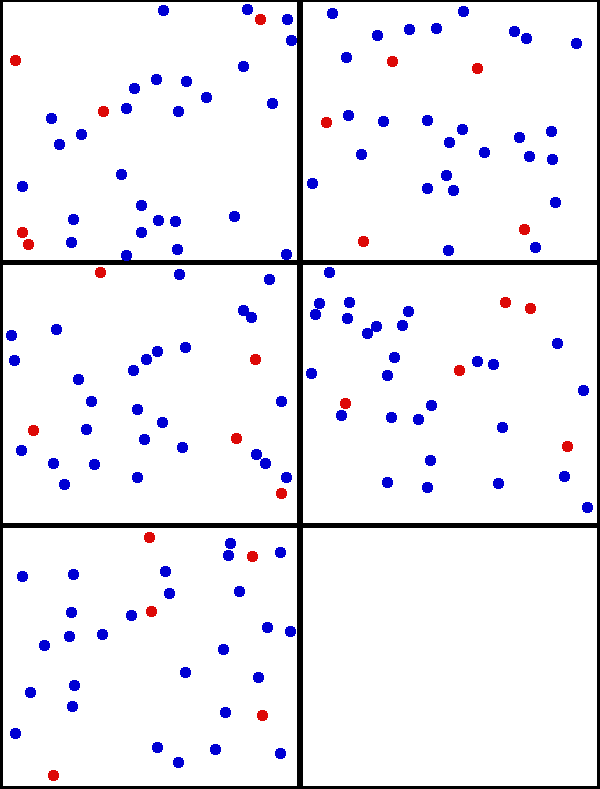
Each gas (blue, red) exerts its own pressure independently — the total pressure is the sum of all partial pressures.
What we call pressure is exactly this drumming: how often the molecules strike the container walls. More molecules — or faster ones — mean more impacts and higher pressure, and each gas adds its own share of impacts: its partial pressure.
🔬 Dalton's Law Formula
Total Pressure
Partial Pressure Calculation
Where:
- p_x = partial pressure of gas x (bar)
- f_x = fraction of gas x in the mixture (decimal, e.g., 0.21 for 21%)
- p_{\mathrm{amb}} = ambient pressure (bar), calculated as 1 + depth/10
Note: This is the operational formula used for MOD and gas limits throughout this section.
⚗️ Example: Air at 30 Meters
At 30 meters, the ambient pressure is 4 bar (1 + 30/10). For air:
| Gas | Fraction | Calculation | Partial Pressure |
|---|
📐 Operational vs Physiological Partial Pressure
There are two common contexts for partial pressure calculations:
Operational (MOD / gas limits)
Used for Maximum Operating Depth (MOD) and oxygen toxicity limits. No water vapour subtraction.
Physiological (tissue kinetics)
When calculating alveolar gas pressures for tissue loading models, we subtract water vapour pressure because the lungs humidify inspired air:
at 37 °C (body temperature)
This ~6% reduction appears in the Bühlmann equations for tissue saturation calculations. We will need this in further sections and stating it here for completeness.
⚠️ Partial Pressure Limits
🔴 Oxygen Limits (pO₂)
Oxygen becomes toxic at elevated partial pressures. The body responds differently to various pO₂ levels:
| pO₂ (bar) | Status | Notes |
|---|---|---|
| < 0.16 | ⚫ Hypoxia | Loss of consciousness, death. Minimum for survival. |
| 0.16–0.50 | 🟢 Normal | Surface breathing range. |
| 0.50–1.40 | 🟢 Safe for diving | Recommended working limit for recreational diving. |
| 1.40–1.60 | 🟡 Caution | Acceptable for decompression stops only. Limited exposure time. |
| > 1.60 | 🔴 Danger | High risk of CNS oxygen toxicity (seizures). |
🔬 Maximum Operating Depth (MOD)
The MOD is the deepest you can safely dive with a specific gas mix without exceeding the pO₂ limit. It's calculated from the oxygen fraction and desired maximum pO₂.
🔬 MOD Formula
Where:
- p_{\mathrm{O_2,max}} = maximum allowed partial pressure (typically 1.4 bar)
- f_{\mathrm{O_2}} = oxygen fraction in the gas (decimal)
Exercises: Calculate the MOD (pO₂ = 1.4 bar)
| Gas | fO₂ | Calculation | MOD |
|---|
💡 Notice: higher O₂ fraction → shallower MOD. More oxygen means you hit the toxicity limit sooner.
🟡 Nitrogen Limits (pN₂) — Narcosis
Nitrogen becomes narcotic at elevated partial pressures, causing impaired judgment, euphoria, and slowed reactions—similar to alcohol intoxication.
🍸 The "Martini Rule"
A popular rule of thumb: every 10 meters of depth on air is roughly equivalent to drinking one martini on an empty stomach. At 30 m, you might feel like you've had 3 martinis!
- 10 m — 1 martini
- 20 m — 2 martinis
- 30 m — 3 martinis
- 40 m — 4 martinis
Note: Individual susceptibility varies greatly. Some divers feel effects earlier, others later. Cold, stress, and fatigue increase narcosis.
| pN₂ (bar) | Equivalent Depth (Air) | Effects |
|---|---|---|
| < 2.4 | < 20 m | Minimal effects for most divers. |
| 2.4–3.2 | 20–30 m | Mild euphoria, slight impairment. |
| 3.2–4.0 | 30–40 m | Noticeable impairment, reduced judgment. |
| > 4.0 | > 40 m | Severe narcosis. Maximum limit for recreational diving. |
Exercises: Max depth for narcosis limit
Same formula as MOD, but for nitrogen: Max depth = ((pN₂,max / fN₂) − 1) × 10
but MOD is {mod} m!| Gas | fN₂ | Calculation | Max depth |
|---|
💡 Nitrox pushes the narcosis limit deeper, but the oxygen MOD kicks in first — you always need to respect both limits. The actual limiting factor for EAN mixes is usually oxygen, not narcosis.
☠️ Oxygen Toxicity
Two Types of Oxygen Toxicity
Breathing oxygen at elevated partial pressures can cause two distinct types of toxicity:
| Type | Cause | Symptoms | Diving Relevance |
|---|---|---|---|
| CNS Toxicity | High pO₂ (>1.6 bar) | Seizures, convulsions, tunnel vision, twitching | Immediate danger, can cause drowning |
| Pulmonary Toxicity | Prolonged exposure (pO₂ >0.5 bar) | Chest pain, coughing, breathing difficulty | Relevant for long exposures, rebreathers |
📊 CNS & OTU Tracking
⚠️ Symptoms of CNS Oxygen Toxicity
Remember the mnemonic VENTID-C:
- Visual disturbances (tunnel vision)
- Ear ringing (tinnitus)
- Nausea
- Twitching (especially facial muscles)
- Irritability, anxiety
- Dizziness
- Convulsions (the most dangerous)
⚠️ If you experience any of these symptoms, immediately signal your buddy and begin ascending. Underwater convulsions are often fatal.